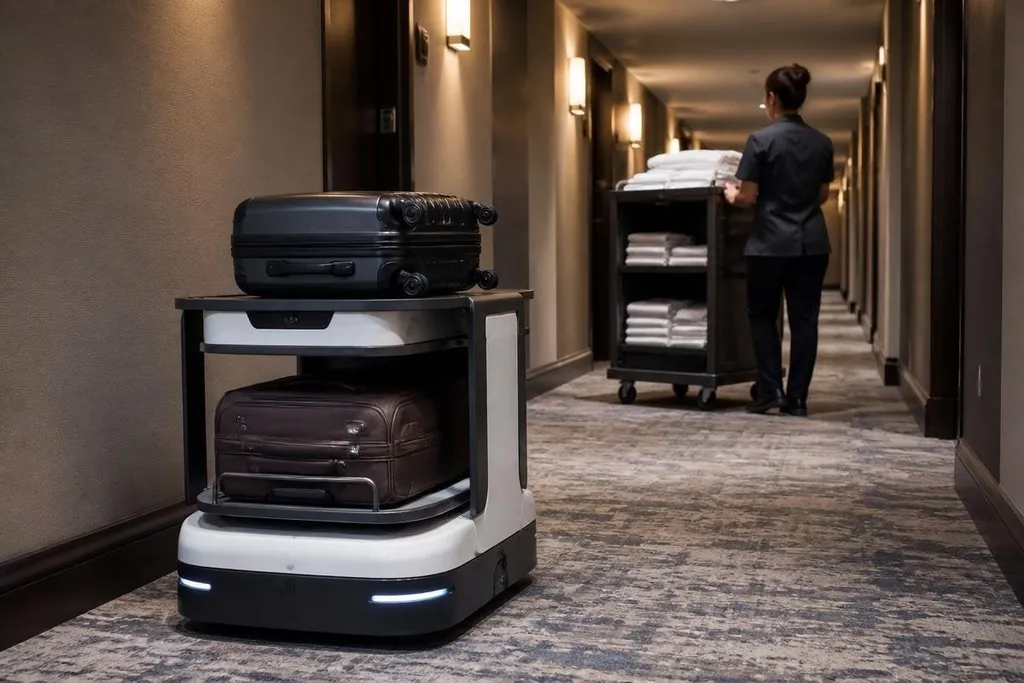
A hotel robot doesn't need to greet guests, mix drinks, or fold towels to earn a place on the property. The first useful jobs are more ordinary: moving luggage, carrying linen, and taking small deliveries through corridors after staff have gone home.
That focus matters because hotels run on repeated trips between rooms, storage areas, kitchens, loading bays, and service lifts. Robots could handle some of those trips while staff spend more time on work that needs judgment, conversation, or a human response.
Quick read
- Start with indoor transport, where routes and drop-off points stay fixed.
- Connect the robot to lifts, doors, and the hotel's work-order system.
- Measure completed trips and missed handoffs before adding more units.
The work hotels can hand to robots
A hotel has many short transport tasks. A robot could move fresh towels from a linen room to a service area, carry room-service orders to a guest floor, or take bags from reception to a room. Each job has a clear start point, an end point, and a repeatable route.
That makes indoor transport easier to plan than work that changes from room to room. A robot can use cameras, LiDAR, and maps to locate itself, then slow down near people and narrow passages. LiDAR measures distance with light pulses, giving the robot a view of walls, doors, and objects around it.
The handoff still matters. A delivery is complete only when the right guest, staff member, or storage area receives it. Hotels would need a way to confirm the destination, open doors safely, and record a failed delivery without sending a worker to search for the robot.
Why night work is an early fit
Late-night service creates a useful test for automation. Fewer people may be moving through corridors, yet guests still ask for water, towels, food, or small supplies. A robot could carry the item while a staff member stays at the desk or handles a task that cannot wait.
That does not remove the need for staff. A guest may need help with a billing problem, a room change, or an access issue. The robot can move an item. It cannot replace the person who decides what should happen when the normal process breaks.
Hotels also need to plan for lifts and doors. A robot that stops at a closed fire door has not finished its route. The property may need lift controls, door sensors, clear floor markings, and rules for people sharing the corridor.
Those building changes can decide whether a hotel robot saves staff time or creates another delivery run. Robot24 gives you a place to compare the robot’s task, site work, and staff handoff before the hotel signs a contract.
Where the business case can fail
The robot's purchase price is only one part of the cost. A hotel may need charging space, network access, lift integration, software support, staff training, and a safe place to store the machine when it is idle.
The building itself can also decide whether the plan works. A property with narrow corridors, heavy carpet, steep ramps, or several disconnected towers may give the robot too many delays. An older lift without a usable control interface can turn a simple delivery into a staff escort.
Guest reaction needs a clear answer too. Some people may like collecting a delivery from a robot. Others may expect a person at the door, especially when the order includes medication, a security concern, or a request that needs explanation. The hotel should make the handoff optional when the task allows it.
I’d start with one route and one shift, then compare the robot's completed deliveries with the staff time it replaces. A large rollout before that check would be a poor use of money.
A practical decision guide
Use these checks before choosing a hotel robot:
- Map one route: Count doors, lift rides, tight turns, and places where guests gather.
- Name the handoff: Decide who receives each item and how the system records success.
- Set a service rule: Give staff a clear way to take over when the robot stops or meets a blocked route.
- Track real work: Measure completed trips, waiting time, battery use, and staff interventions.
- Check the building: Test floors, carpets, ramps, lift controls, fire doors, and network coverage.
- Ask guests first: Use a small trial to learn which deliveries they accept from a robot.
The best first deployment is narrow enough to measure and useful enough to matter. Luggage runs, linen movement, and late-night deliveries meet that test more often than a robot built to handle every hotel task.
The next decision is practical: can one route run for a full shift with fewer staff interruptions than the current process? If the answer is no, the hotel needs a better route, not more robots.